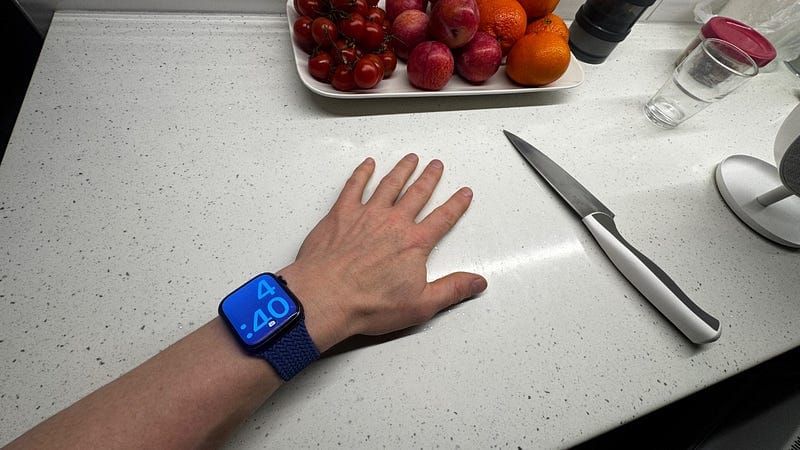
For years, I wore my Apple Watch almost all the time. Every workout recorded. Every ring closed. Every day captured. A few weeks ago something has changed.
The Moment
On February 4th, I went to a dance class and, for the first time, I took my Apple Watch off after starting the session. It stayed next to my water bottle, a few meters away from me, while I continued dancing. I had already been thinking about it for a few days.
“I’m considering leaving my Apple Watch for dance lessons.” (Feb 3, 2026)
During that class, the only thing I noticed was simple: I didn’t know the time.
“The most missing thing was… not knowing the time. Which was quite ok, I think.” (Feb 4, 2026)
There was no urgency to fix it.
The Experiment
This change didn’t start in February. It has a longer history. When I bought one of my earlier Apple Watches, I wrote:
“I hope it will help me solve at least a few of my problems. Maybe even all of them.” (Sep 25, 2023)
Over time, that expectation translated into behavior. I tracked almost everything: workouts, steps, sleep, food, water. I closed rings, recorded sessions, and treated the device as a constant companion. The purpose was not only health — it was also data completeness. At the same time, there were early signals of friction.
“It annoys me. It’s too big. It bothers me during dance. More and more often I feel like taking it off.” (Jul 8, 2024)
Dance made the conflict visible. I train jazz, modern jazz, and contemporary. There is floorwork, contact with the ground, and continuous movement. The watch was getting scratched. It was also visible in recordings of choreography, and it didn’t fit. I had already seen a version of this during my first performance, where I didn’t wear it. Someone reminded me before going on stage, but I already knew — it didn’t belong there.
Adaptation
The first sessions after February 4th were not dramatic. The watch was still present — just not on my wrist. I usually start the class with it, sometimes use it during warm-up, and then put it aside before working on choreography. There was no strong urge to put it back on. Earlier, this would have triggered a reaction: incomplete workouts, open rings, missing records. Now it didn’t.
The absence was noticeable but limited. I lost quick access to time. I also lost a specific function I relied on — capturing music. During classes, when I hear a song I like, I usually record a short fragment and identify it later. Without the watch, those songs disappear. At the same time, dance requires attention. New movements, new sequences, constant correction. Without the watch on my wrist, there was one less element competing for that attention.
Observations
Looking across my notes, the role of the Apple Watch has been inconsistent. In some situations, it was clearly useful. During one training session, my heart rate exceeded 200, and I used the watch to monitor recovery in real time.
“My heart rate exceeded 200… I couldn’t calm down… I watched the moment when I finally returned to normal.” (Nov 5, 2024)
In another case, after eating a heavy meal, it showed elevated heart rate and breathing during sleep.
“Apple Watch showed elevated heart rate and breathing at night… and it’s not the first time.” (Oct 4, 2024)
I also used it to observe patterns like improved sleep when experimenting with sleeping on the floor. But there are also contradictions.
“Apple Watch says the night was okay… but I felt mentally overheated, thirsty, not fully rested.” (Feb 7, 2026)
Both signals existed at the same time, without resolution.
Over the last few weeks, my usage pattern has stabilized. I wear the watch during gym classes, where the activity is repetitive and data aligns with the task. I often start dance classes with it and then remove it after warm-up, placing it next to my water bottle and phone. Outside of training, I use it for small, practical functions: checking messages, controlling music, seeing notifications, occasionally capturing audio. Sometimes I leave it on the charger in the morning and notice the absence, but without the earlier sense of loss. The earlier system depended on completeness. Data had to be continuous. Now, data is intermittent and contextual.
Conclusion / Current State
The Apple Watch remains part of my daily environment, but its role has changed. It is no longer something I have to wear in order to maintain a system. It is a device I use when it fits the activity. In dance, it usually stays off my wrist but within reach. In gym training, it stays on. At home, sometimes it remains on the charger. The functions I value — notifications, music control, quick capture — are still present, but they no longer define how I organize my behavior. This adjustment is ongoing. The device did not change. My use of it did.