An Experiment in Health, Minimalism, and Adaptation
Introduction
On 15 July 2024, I removed my bed.
This wasn’t a reaction to pain, injury, or dissatisfaction. I had been sleeping in a normal bed for years without major issues. The decision came from somewhere else — from the ongoing process of changing how I live. Around that time, I was already modifying many aspects of my life: movement, food, routines. Sleeping on the floor felt like a small, reversible experiment that fit naturally into that direction.
I had also started dancing months earlier — contemporary and modern jazz. Floorwork became part of training: rolling, sliding, staying close to the ground. The floor was becoming familiar in movement. I became curious what would happen if it also became familiar in rest.
Health was the primary motivation. Not because something was wrong, but because I wanted to test whether something could be better.
The morning after the first night, I wrote in my diary:
First night on the floor. So far it’s ok, though I can’t fall asleep, but that’s because I slept until noon.
The tone was neutral. So was the night.
Method
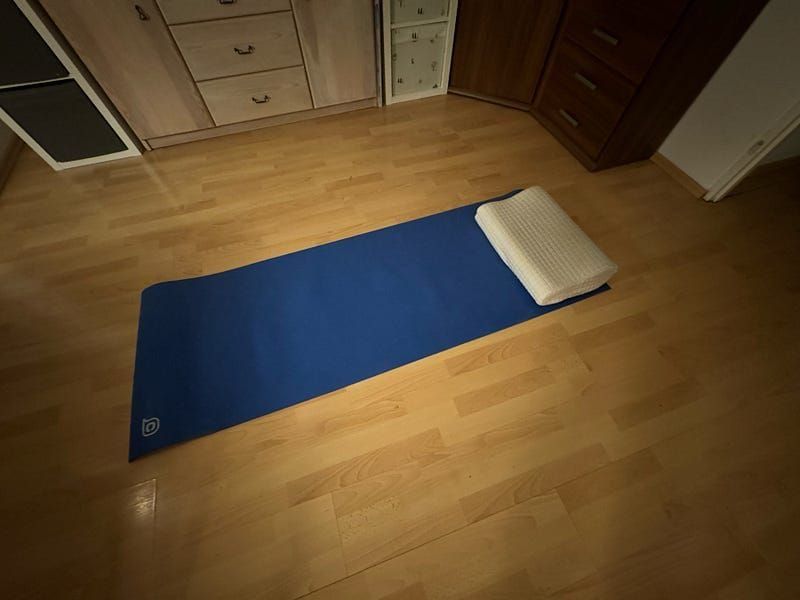
I started with a yoga mat placed directly on the floor. That was the first version. I kept my bed at the beginning, assuming I might return to it.
The first few nights were unusual but not extreme. I noticed my muscles more. There was mild stiffness, as if the body had to reorganize how it distributes weight. But it wasn’t a shock. At that time, my regular bed wasn’t particularly comfortable either, so the transition wasn’t dramatic — just different.
After some time, I tested a thicker camping mat. Surprisingly, it felt worse. Too soft. That was the first practical observation: firmness mattered.
Six months after that first night, I moved to a new place. This time, I didn’t bring a bed with me. By then, I already knew the experiment had worked. Sleeping without a bed had quietly become my normal way of living — another change that initially seemed uncomfortable but turned out to bring a different kind of comfort.
Eleven months later, I removed the yoga mat entirely and bought a carpet. Since then, I sleep directly on it, using a thin quilt folded underneath and the same quilt on top, together with an ergonomic pillow. The pillow turned out to be more important than expected; without proper neck support, the whole setup would likely have failed.
Adaptation
The adaptation period was gradual. The body adjusted. The early stiffness disappeared and was replaced by something else — a sense of stability. In winter, the colder surface required attention to room temperature. I became more aware of how temperature differs between sleeping half a meter above the floor and sleeping directly on it.
At some point, I researched the topic. Is sleeping on the floor healthy? Is it harmful to the spine? Why is softness considered standard? What I found was not a simple split of opinions. People who had actually tried it often described benefits for their back and sleep quality, while most criticism came from those who had never tested it. Scientific sources generally suggested that a firm surface can support spinal alignment, provided the pillow and overall setup are appropriate. The potential drawbacks I encountered — pressure points, worsened allergies, cold exposure, and mobility challenges — were largely environmental or lifestyle-related rather than clear medical contraindications. None of them convinced me to stop. In the end, research informed the context, but observation remained the decisive factor.
An unexpected side effect appeared during Body Balance gym classes. After sessions, there is a short meditation on yoga mats. Several times I fell asleep within minutes. My body had associated the floor with sleep. To avoid that, I began sitting cross‑legged during the meditation phase. Conditioning had taken place.
Observations
Over time, certain patterns became consistent. Falling asleep became faster. When I lie down on the carpet, there is little transition — sleep arrives quickly. The surface is used almost exclusively for sleeping, which may strengthen that association.
There is also a clear physical sensation at the end of the day. Lying down on a firm surface produces a kind of bodily relief that I did not notice when using a bed. It feels structurally supportive rather than cushioning.
Mornings feel stable. My back feels aligned and less stiff than in previous years. Apple Watch metrics indicate improvement in sleep quality compared to earlier periods.
However, this cannot be isolated. During the same time, I increased physical activity, trained dance regularly, changed diet, and became more aware of temperature and recovery. The floor is one variable among several.
Still, the general signal is consistent: my body feels better now than before.
Conclusion
After nearly two years, sleeping on the floor no longer feels experimental. It feels normal. Returning to a bed would now feel excessively soft.
The experiment began as a health question. It evolved into something simpler: a change that stayed. It required adjustment, but not sacrifice. It did not solve everything, and it may not be universally optimal.
It remains one documented change in how I live — observed, tested, and kept.